

Best time to visit Cluj-Napoca
Romania · Europe
All twelve months scored on daily temperature, rainfall, humidity and holiday crowding.
The year in Cluj-Napoca
Tap a month for its page
- JanJCluj-Napoca in January: avoid
- FebFCluj-Napoca in February: ok
- MarMCluj-Napoca in March: good
- AprACluj-Napoca in April: sweet spot
- MayMCluj-Napoca in May: sweet spot
- JunJCluj-Napoca in June: good
- JulJCluj-Napoca in July: sweet spot, busy
- AugACluj-Napoca in August: sweet spot, busy
- SepSCluj-Napoca in September: good, busy
- OctOCluj-Napoca in October: good
- NovNCluj-Napoca in November: ok
- DecDCluj-Napoca in December: avoid
- Sweet spot
- Good
- OK
- Avoid
- Busy
Plan this trip
Each site opens on its own search: choose your dates there. A few open on their home page, where you type the place too.
Links marked Ad pay us a commission if you book, at no extra cost to you; most pay nothing, and what a site pays never decides whether it is listed or where. How we rank
Flights from
Flights
Your city is a guess from your time zone. Choose your city
Where are you flying from? Choose your city for its flights and fares.
Book with the airline
Where to stay
Book direct
Luxury
Things to do
Car hire
Rent direct
Travel insurance
Check whether your bank card or home insurance already covers this trip.
If the trip needs a visa, the travel agent or visa centre usually sells the cover it asks for.
Mobile data (eSIM)
Your own plan's EU roaming may already cover this.
Renting a pocket Wi-Fi is the other common way to stay connected.
These are sites people in book with. Each opens in a new tab, on the site's own pages.
Things to do in Cluj-Napoca
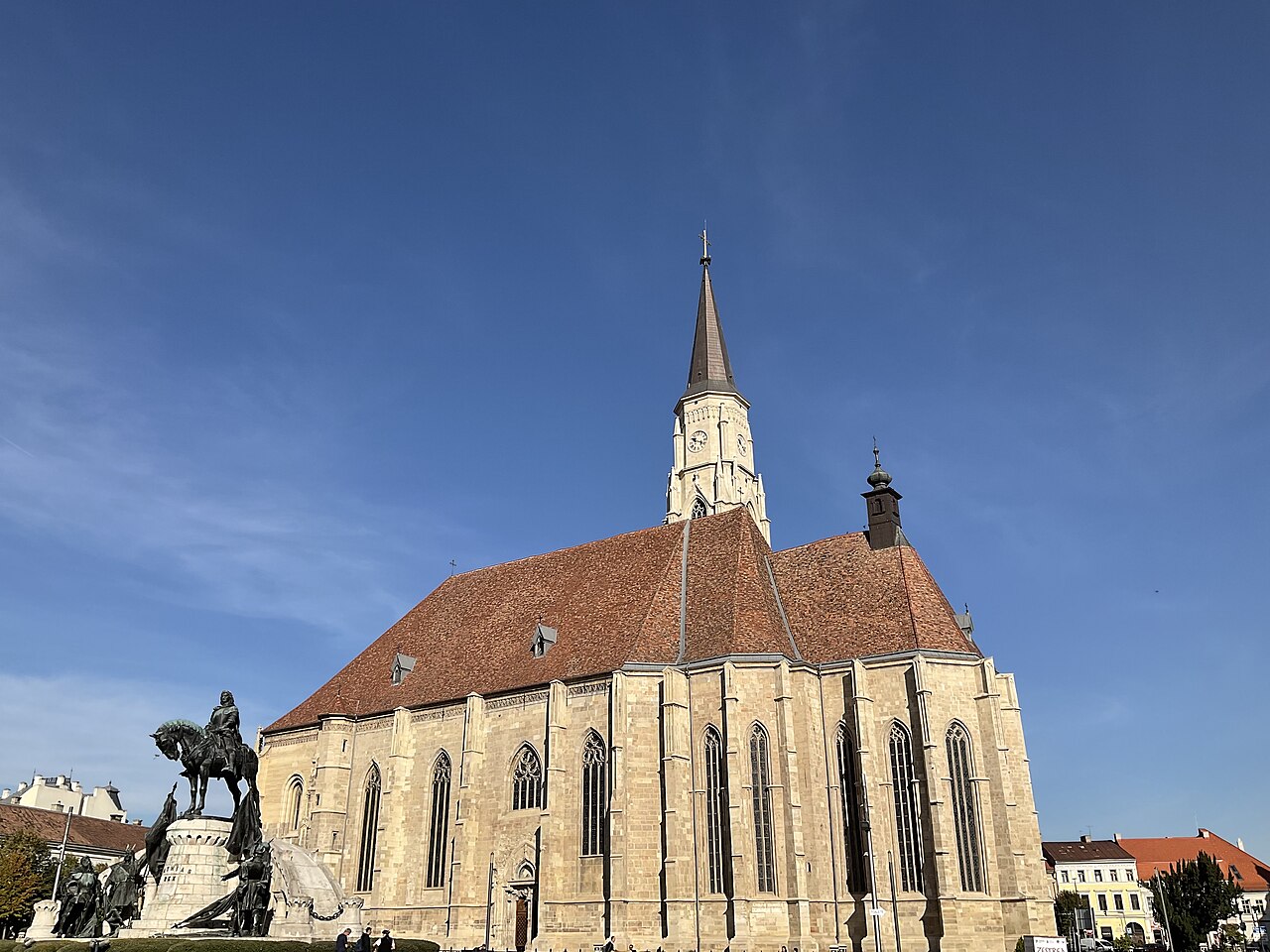
- St. Michael's Church This Gothic architecture piece is one of the most valuable in Transylvania.
- The Orthodox Cathedral Heritage site in Cluj County, Romania
- Statue of Matthias Corvinus The statue is often climbed by tourists, although officially this practise is not allowed.
- Matthias Corvinus House Heritage site in Cluj County, Romania
- Ethnographic Museum of Transylvania Museum in Cluj-Napoca, Romania
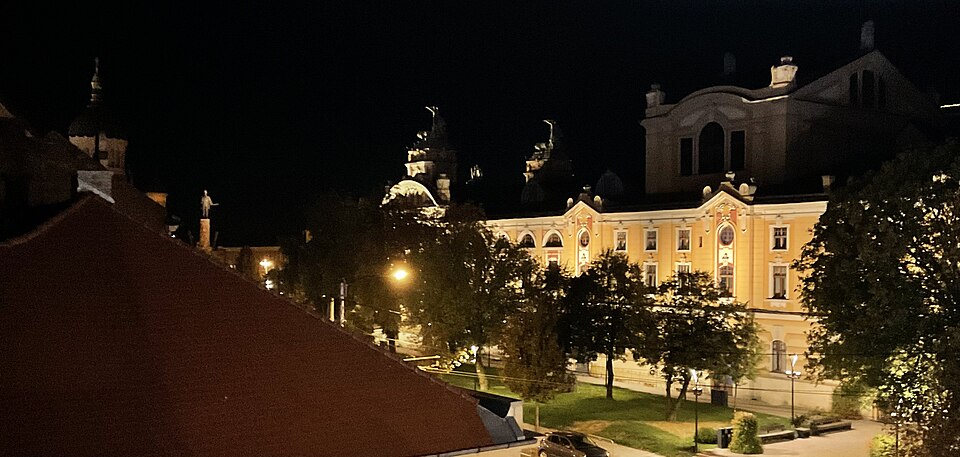
- Bánffy Palace Built between 1774 and 1775, it houses the National Art Museum
- Lucian Blaga National Theatre Theatre in Cluj-Napoca, Romania
Tours and tickets in Cluj-Napoca
Each site opens on its own search: choose your dates there. A few open on their home page, where you type the place too. Links marked Ad pay us a commission if you book, at no extra cost to you; most pay nothing, and what a site pays never decides whether it is listed or where. How we rank
Sights and their lines from Wikivoyage (Cluj-Napoca), licensed CC BY-SA 4.0, and Wikidata; in order of how often each one's Wikipedia article was read on phones in the last 12 months.
Month by month
No fare history for this route yet, so this ranking is climate and crowds only — the price column will fill in as the scanner collects.
| Month | Max °C | Rain days | Humidity | Sun h/day | Verdict | Why |
|---|---|---|---|---|---|---|
| Jan | 3° | 6d | 83% | 5.1h | avoid | bitter cold: 3C daily max |
| Feb | 7° | 6d | 76% | 6.4h | ok | 7C max, 6 rainy days |
| Mar | 11° | 7d | 70% | 8.4h | good | 11C max, 7 rainy days |
| Apr | 16° | 7d | 67% | 10.3h | sweet spot | 16C max, 7 rainy days |
| May | 20° | 11d | 71% | 11.6h | sweet spot | 20C max, 11 rainy days |
| Jun | 25° | 9d | 71% | 13.1h | good | 25C max, 9 rainy days |
| Jul | 26° | 7d | 68% | 13.1h | sweet spot busy | busier than usual |
| Aug | 28° | 4d | 66% | 12.2h | sweet spot busy | busier than usual |
| Sep | 22° | 6d | 71% | 10.2h | goodbusy | busier than usual |
| Oct | 16° | 6d | 76% | 8.3h | good | 16C max, 6 rainy days |
| Nov | 9° | 8d | 86% | 5.4h | ok | 9C max, 8 rainy days |
| Dec | 5° | 6d | 87% | 4.6h | avoid | bitter cold: 5C daily max |
Rain days are the days with at least 1 mm of rain, as a weather station counts them.
Weather read at the centre, 7 km from the airport (CLJ): ten years of ERA5 and ERA5-Land reanalysis, through Open-Meteo's open data.
A busy month is a crowded one, not a bad one — usually it is crowded because the weather is good. It is flagged rather than scored down, and crowds alone never make a month “avoid”: that is reserved for weather worth skipping.
How busy it gets
Then and now
Cluj-Napoca's August days now average 27.7°C, 4.5°C warmer than in 1981–1990. 9 of 12 months are clearly warmer.
| Jan | Feb | Mar | Apr | May | Jun | Jul | Aug | Sep | Oct | Nov | Dec | |
|---|---|---|---|---|---|---|---|---|---|---|---|---|
| 1981–90 | 0.8° | 2.4° | 8.8° | 14.2° | 19.2° | 21.1° | 23.2° | 23.2° | 20.0° | 14.3° | 6.7° | 2.6° |
| 2017–26 | 2.9° | 6.5° | 11.1° | 15.7° | 19.9° | 25.2° | 26.5° | 27.7° | 22.0° | 16.2° | 9.5° | 4.7° |
| Change | +2.1° | +4.1° | +2.3° | +1.5° | +0.7° | +4.1° | +3.3° | +4.5° | +2.0° | +1.9° | +2.7° | +2.1° |
The average daily high, month by month, for the nearest ERA5 grid cell. Bold is a clear change; grey is within the ordinary spread between years. Every destination, ranked.
Getting there
How far Cluj-Napoca is, and what it costs, depends on where you set off from — the months above do not.
Open in Rome2rio for every way from to Cluj-Napoca, flying or not.
Before you go
Type C and F plugs at 230 V. Drives on the right. The currency is the Romanian leu. No UK Foreign Office advice against travel. Global Affairs Canada: Exercise normal security precautions. US State Department: Level 1: Exercise Normal Precautions. Everything for Romania: cost of living, languages, emergency numbers and health.
Being there
On arrival
- Paying — The currency is the leu (RON). Everyday life runs largely on cash, though cards are widely accepted in the big cities. Change euros only at banks, exchange offices or hotels, as changing money in the street is illegal; carry crisp notes, since worn ones may be refused, and use ATMs inside banks or in well-lit public places.
- UPI, for visitors from India — Not accepted for paying here; bring a card that works abroad.
- Tipping — A tip of 5 to 10% is usual in restaurants, cafés and taxis and at hairdressers.
Getting around Cluj-Napoca
- Apps — Rides: Bolt, Uber. Maps: Google Maps, Apple Maps. Taxi drivers sometimes overcharge visitors: take a licensed, metered taxi showing its company name and price list on the side, check the meter runs at that rate (higher at night and outside the city), and order one through your hotel or an app rather than hailing it in the street.
Public transport in the city is possible by means of 25 bus lines, 7 trolleybus lines, and 3 tram lines, all operated by the RATUC company (Regia Autonomă de Transport Urban de Călători). More on Wikivoyage
From the Wikivoyage article on Cluj-Napoca, written by travellers and licensed CC BY-SA 4.0.
Help
- Emergency — 112 (any emergency).
TravelCharika is not an emergency service: we cannot call for help or send anyone. Numbers can change; if one fails, ask someone local or your hotel.
Your embassy — : how to reach your embassy or consulate abroad. A guess from your city, : a city is not a passport.
Put together by hand from the sources listed, checked 8 October 2026. Apps, cards and rules change, so check before you rely on one.
Sources (16)
- gov.uk/foreign-travel-advice/romania/getting-help
- gov.uk/foreign-travel-advice/romania/safety-and-security
- travel.gc.ca/destinations/romania
- bolt.eu/en/cities/bucharest
- uber.com/global/en/cities/bucharest
- stb.ro/linie?100
- stb.ro/pdf_linii/100%20Tur.pdf
- stb.ro/pdf_linii/100%20Retur.pdf
- stb.ro/tarife
- stb.ro/modplata
- stb.ro/carduri
- en.wikivoyage.org/wiki/Romania
- developers.google.com/maps/coverage
- apple.com/ios/feature-availability
- pib.gov.in/PressReleasePage.aspx?PRID=2286608
- rbidocs.rbi.org.in/rdocs/AnnualReport/PDFs/09PAYMENT290526C6588B796E664822A2BD0DEB6452CAD4.PDF
Cluj-Napoca in pictures
i
Choinowski, CC BY-SA 4.0, via Wikimedia Commons
i
Alexmandru, Public domain, via Wikimedia Commons
i
Rosenborg BK Fan, CC0, via Wikimedia Commons
i
Stefano Vigorelli, CC BY-SA 4.0, via Wikimedia Commons
What Cluj-Napoca is like
Cluj-Napoca (Romanian), Kolozsvár (Hungarian) or Klausenburg (German) is the capital of Cluj county and the unofficial capital of the historical region of Transylvania. More on Wikivoyage
- Worth seeing
- The area around the Union Square is a must see for the visitor, with the Teleki and Banffy Palaces (the latter now housing the National Art Museum), the Franciscan Monastery, the first Unitarian Church in the world… More on Wikivoyage
- Worth doing
- Lucian Blaga National Theatre (Teatrul Național Lucian Blaga). Romanian National Opera (Opera Naţională Română). Housed in the same building as the National Theatre. More on Wikivoyage
- Getting in
- Getting to Cluj-Napoca is easy due to its position and its status as a major Transylvanian city. Cluj-Napoca railway station (Gara Cluj-Napoca), Piața Gării 1-3. More on Wikivoyage
- Staying safe
- Cluj-Napoca is in general a safe city. Even after dark, it is safe to walk through the city center and some of the other neighbourhoods. More on Wikivoyage
From the Wikivoyage article on Cluj-Napoca, written by travellers and licensed CC BY-SA 4.0; the full article has far more. The numbers above are measured; this is experience.
Around Cluj-Napoca
Also in Romania
Nearby
Kind of place
Cluj-Napoca is in Romania, Europe. Distances are great-circle, so a short one can still be a long way round.
Check your inbox. A confirmation is on its way: open the link in it, press Confirm, and you are subscribed.
That did not go through. Check the address, or try again in a minute.
Already sent. A confirmation went to that address in the last day: look for it, spam folder included. Its link works for three days.
You are not on the list until you confirm from your inbox. The list lives with our email provider, Resend; the privacy page says the rest.
Links marked Ad pay us a commission if you book through one, at no extra cost to you. That does not affect the scores on this page, which are computed from climate and fare data before any link is built.